
Menü öffnen Menü schließen

What Is a Manual Ceramic Coffee Grinder Used For?

A Manual Ceramic Coffee Grinder is used to turn whole coffee beans into grounds just before brewing. Its hand-cranked burrs let you choose a grind size for pour-over, French press, or espresso. Coarser grounds look like small, uneven grains; finer grounds feel closer to table salt. The adjustment is practical, not decorative. It changes how quickly water passes through the coffee.

Coffee educator James Hoffmann’s guidance can be paraphrased this way: “A grinder should produce grounds suited to your brewing method.” This is a paraphrase, not a verbatim quotation. Ceramic burrs need no electricity and resist corrosion, making the grinder useful in a small kitchen, at a desk, or while camping. A measured 15 grams of beans, a soft burr-click, and a steady turn of the handle make the process tangible. It is especially useful for one or two cups, without powering a larger electric grinder. Cleaning the burr chamber helps keep old coffee residue from affecting fresh grounds.

Still, ceramic does not guarantee a better cup. Burr alignment, bean freshness, grind setting, and technique all matter. Hand grinding takes time. Very fine settings can require extra effort, especially with light-roasted beans. This guide explains what the grinder is designed to do, where it fits, and what it cannot promise. The honest answer is less glamorous, but more useful: it offers control and portability, not effortless perfection.
What Is a Manual Ceramic Coffee Grinder Used For?

What a Manual Ceramic Coffee Grinder Is

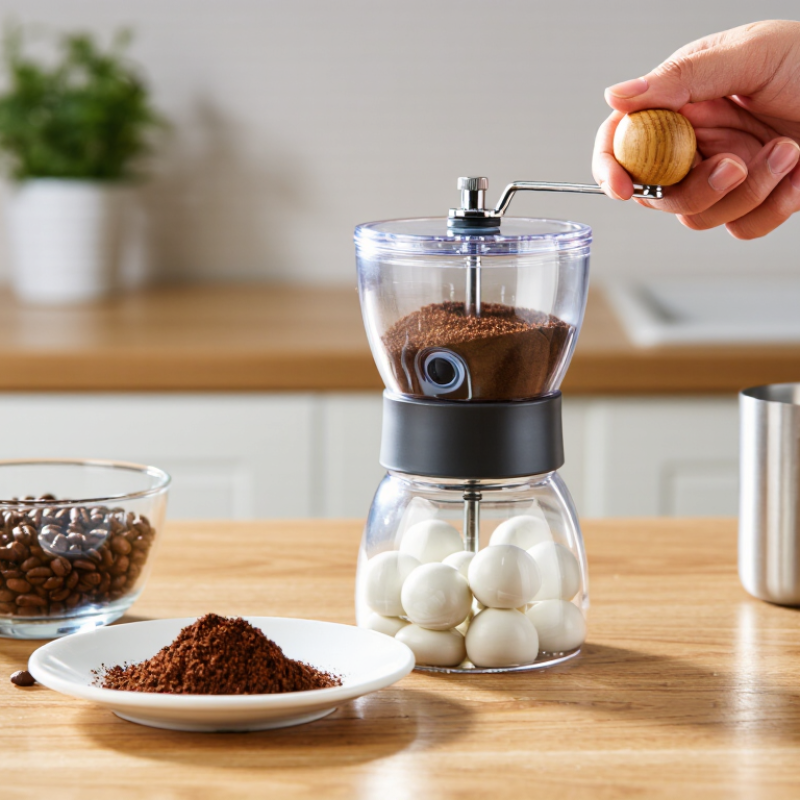
A manual ceramic coffee grinder is a hand-operated tool that crushes whole coffee beans between two shaped ceramic burrs. Turning a small crank moves one burr against the other, producing grounds that fall into a container below. Unlike a blade grinder, it aims to create more consistent particle sizes, which can help water extract coffee more evenly. No motor is involved. The user supplies the turning force.

Most models have a bean hopper, a crank, an adjustment mechanism, and a grounds cup. The adjustment changes the distance between the burrs: a wider gap generally gives coarser grounds, while a narrower gap gives finer ones. This lets a person prepare coffee for methods such as French press or pour-over. The exact setting varies between grinders, so a little testing is normal. It can feel fiddly. Ceramic burrs resist rust and do not transfer much heat during hand grinding, but they can chip if dropped on a hard floor. A steady turn and a dry brush for routine cleaning are usually sensible habits. The crank may also feel tiring when grinding a large batch, a small drawback that is easy to overlook.

How Its Grinding Mechanism Works

A manual ceramic coffee grinder turns hand motion into a controlled crushing action. When you rotate the crank, a central shaft moves one burr against another. Whole beans drop into the space between them, where the burrs break them into smaller particles. They are crushed, not chopped by fast-spinning blades. No motor hum.

Most models use an adjustment dial or nut to change the distance between the burrs. A smaller gap usually produces finer grounds; a wider gap produces coarser ones. The grounds fall through the burr assembly into a cup or drawer below. Turn the handle steadily, and beans feed through the mechanism at a measured pace. That matters.

The ceramic burrs are hard and resist rust, but they are not indestructible. A fall or a hard foreign object can chip them. Grind size also depends on burr alignment, bean type, and how firmly the adjustment is set. The mechanism is simple, but not perfectly self-correcting: two grinders set to the same mark may produce slightly different results. A small test dose can reveal whether the grounds suit a pour-over, French press, or espresso basket.

What Is a Manual Ceramic Coffee Grinder Used For? - How Its Grinding Mechanism Works
Dimension How It Works or What It Is Used For Practical Details
Main purpose Grinds whole coffee beans by hand immediately before brewing. Freshly ground coffee is ready to use in methods such as pour-over, French press, or drip brewing.
Ceramic burrs Two shaped ceramic burrs work together to crush and shear beans into smaller particles. The burr gap determines the approximate particle size; ceramic burrs are hard and resist corrosion.
Crank mechanism Turning the handle rotates one burr while the other remains fixed within the grinder body. Manual operation needs no electricity, but grinding requires physical effort and takes longer than many powered grinders.
Grind adjustment An adjustment dial, nut, or ring changes the distance between the burrs. A smaller gap generally produces a finer grind; a larger gap generally produces a coarser grind. Adjustment steps vary by design.
Bean and grounds path Beans enter through a hopper, pass between the burrs, and fall into a collection chamber. Capacity is usually suited to a small number of servings. Check the product’s stated capacity for exact amounts.
Brew-method matching Changing the grind setting helps prepare coffee for different brewing methods. Coarser settings are commonly used for French press, medium settings for many drip methods, and finer settings for espresso-style brewing. The usable range depends on the grinder.
Portability The hand-cranked design can be used without a power outlet. Its compact size can suit travel or small kitchens, although grinding a larger batch by hand takes more time.
Cleaning and care Loose grounds can be removed from the hopper, burr area, and collection chamber. Follow the grinder’s care instructions. Avoid immersing parts unless they are specifically marked as washable.
Important limitation Ceramic burrs are hard but can chip or crack if subjected to a strong impact. Keep the grinder from being dropped and remove foreign objects from the beans before grinding.

What Coffee Preparation It Is Used For

What Is a Manual Ceramic Coffee Grinder Used For?

A manual ceramic coffee grinder prepares whole beans for home brewing, especially pour-over, drip coffee, French press, and AeroPress. Its adjustable burrs let you choose a finer grind for quick extraction or a coarser one for immersion brewing. The hand crank needs no electricity, so it suits small kitchens, travel, and quiet early mornings.

The National Coffee Association’s 2024 National Coffee Data Trends report found that 82% of past-day coffee drinkers had coffee at home. For home brewing, freshly ground beans offer a simple way to control grind size and timing.

Grind size affects how quickly water extracts flavor. For French press, try a coarse texture, like rough sea salt; for pour-over, start around medium. The Specialty Coffee Association recommends brewing water between 195°F and 205°F. A grinder cannot control water temperature, but it helps make your preparation more repeatable.

One limitation is easy to miss: hand grinding takes effort, and some ceramic burr models may not produce a fine, even grind for espresso. A little trial and adjustment is normal.

Tips: Grind just before brewing, and change only one variable at a time. If a cup tastes thin, try a finer setting; if it tastes harsh, go coarser. Note your setting and brew method. The notes may not be perfect, but they help.

How Grind Size Affects Brewing Methods

A manual ceramic coffee grinder turns whole beans into grounds while letting you control their size. That control matters because water moves through fine and coarse coffee at different speeds. A small adjustment can change the cup.

For pour-over, a medium grind often gives water time to pass through the bed without leaving the coffee flat or overly sharp. If the brew drains too quickly and tastes thin, try a slightly finer setting. If it drips slowly and tastes bitter, go a little coarser. Change one thing at a time. It is easy to blame the grind when the pour or water temperature may also be responsible.

French press usually suits a coarse grind, with particles that look like rough sea salt. Too many fine particles can slip through the filter and leave a muddy finish. For espresso, a much finer grind is generally needed, but some manual grinders lack the adjustment range for consistent shots. There is no magic setting. Bean freshness and brewing equipment matter, too. Keep notes, even if they are imperfect, and use taste as your guide rather than chasing an exact number.

Key Benefits and Limitations of Manual Grinding

What Is a Manual Ceramic Coffee Grinder Used For?

Key Benefits and Limitations of Manual Grinding

A manual ceramic coffee grinder crushes roasted beans into grounds for brewing, with grind size adjusted for methods such as pour-over, French press, or espresso. Its hand crank needs no power, and the compact body fits easily in a travel bag. Ceramic burrs resist corrosion, but they can chip if dropped. Grinding also takes time. You will feel it most with a large dose or very light, hard beans.

The Specialty Coffee Association’s Brewing Control Chart places a common brewed-coffee extraction target at 18–22 percent, with a beverage strength of 1.15–1.35 percent total dissolved solids. These are brewing benchmarks, not proof that any hand grinder produces uniform grounds.

A practical limitation is uneven particle size: fine dust can taste bitter while larger pieces remain sour. A slow, steady crank may help, but it cannot fix worn burrs or poor adjustment. Manual grinding offers control and quiet operation; it also asks for patience. That trade-off is easy to underestimate. If you brew several cups each morning, the extra effort may matter more than the grinder’s portability.