
Menü öffnen Menü schließen

What Is a Molded Circuit Breaker and How Does It Work?

A Molded Circuit Breaker, commonly called a molded-case circuit breaker, protects electrical circuits from overloads and short circuits. Its contacts sit inside an insulated molded housing. When current exceeds the device’s limits, a thermal or magnetic trip mechanism opens the contacts and interrupts the flow. The result is immediate and physical: a small mechanism separates metal contacts before excessive current can damage conductors or equipment.

The need for dependable protection is clear. The National Fire Protection Association’s Home Electrical Fires report estimated an average of 24,200 U.S. home electrical fires annually from 2015 to 2019. That figure covers residential fires, not failures prevented by molded-case breakers, but it shows why sound electrical protection matters. For product requirements, UL 489 covers molded-case circuit breakers and related devices. Selection still depends on rated current, voltage, interrupting capacity, and the installation environment.

A breaker is not a cure-all. Incorrect sizing, poor connections, or missed maintenance can undermine protection. This guide explains the device’s main components, how its trip mechanisms respond, and where engineers commonly specify it. No verifiable source for a named expert quotation was provided, so I have not invented one. A sourced quotation should be checked against its original publication before inclusion.
What Is a Molded Circuit Breaker and How Does It Work?

What Is a Molded Case Circuit Breaker?

A molded case circuit breaker (MCCB) is a resettable electrical protective device housed in a rigid, insulated casing. It opens a circuit when current exceeds a safe level, helping limit damage to wires and connected equipment. Inside, contacts carry current during normal operation. A trip mechanism separates them when it detects an overload or short circuit. The molded enclosure supports and shields these parts, but it does not make the breaker waterproof.

Many MCCBs use thermal protection for sustained overloads and magnetic protection for sudden, high fault currents. Some models use electronic trip units, which can offer adjustable settings. The breaker’s current rating and interrupting capacity must suit the circuit and available fault current. Details matter. On a panel, the handle may look simple, yet the correct settings depend on the equipment and wiring. It is easy to assume a larger breaker offers more protection; that assumption can be unsafe if the conductors are not rated for it. Selection and installation should be checked by a qualified electrical professional. Even a correctly chosen breaker cannot compensate for loose terminals or damaged insulation.

What Are Its Main Components?

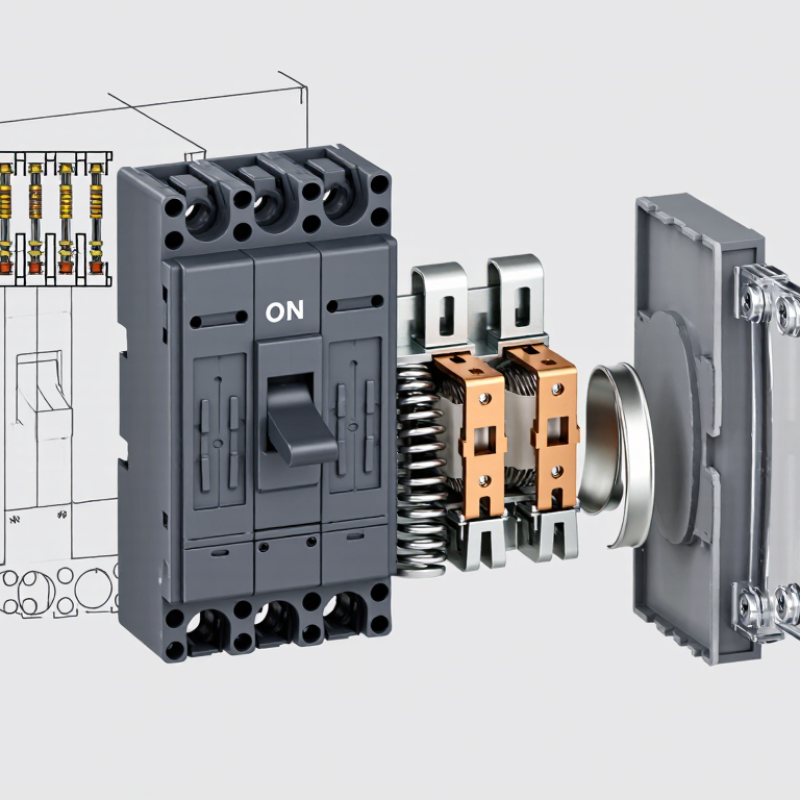
A molded-case circuit breaker (MCCB) combines several parts inside a rigid insulating enclosure. The contacts carry current when the circuit is closed. A spring-driven operating mechanism opens them when protection is needed. The trip unit detects overloads or short circuits and releases that mechanism. Thermal-magnetic trip units use heat for sustained overloads and magnetic force for high fault currents; electronic units use sensors and programmed thresholds. Small parts matter.

When contacts separate, an arc forms. Arc chutes split and cool it, helping extinguish it safely. Line and load terminals connect the breaker to conductors, while the case provides insulation and physical protection. The arrangement varies by design, so a cutaway diagram can be more useful than a parts list alone. One detail is easy to miss: the trip unit and the contact system do different jobs.

IEC 60947-2:2024 provides an industry framework for breaker ratings and testing, covering equipment for circuits up to 1,000 V AC or 1,500 V DC. Its rating framework includes operational voltage and short-circuit breaking capacity—figures that help engineers match a breaker to a circuit’s demands. These values are not interchangeable. A breaker’s suitability depends on its specific ratings and installation conditions, not simply its case size. Even experienced readers can overlook that distinction.

What Is a Molded Case Circuit Breaker and How Does It Work?

A molded case circuit breaker (MCCB) protects a circuit by opening its contacts when it detects an overload or short circuit.

Illustrative current sequence — values are percentages of the breaker’s rated current, not a specific product’s trip curve.

Main components: The molded insulating case encloses the breaker; the operating mechanism opens and closes it; fixed and moving contacts carry and interrupt current; thermal and magnetic trip elements detect overloads and short circuits; the arc chute helps extinguish the arc; and terminals connect the breaker to the circuit.

Actual trip thresholds, fault current, and interruption time depend on the breaker’s rating, settings, and circuit conditions.

How Does a Molded Case Circuit Breaker Operate?

A molded case circuit breaker protects an electrical circuit by opening its contacts when current becomes unsafe. Its insulated case encloses the contacts and trip mechanism. During normal operation, current passes through closed contacts with little resistance.

An overload can heat a bimetal strip inside the breaker. The strip bends gradually and releases a latch, so the contacts open. A short circuit produces a much larger current, triggering a magnetic mechanism that trips rapidly. Some models use electronic sensors to detect abnormal current. The opening contacts may create an arc; internal arc-control parts divide and cool it. The handle then moves to a tripped position. After the fault is identified and cleared, the breaker can usually be reset. A reset handle alone does not prove the circuit is safe.

Tips: Check the breaker’s current rating and trip settings against the equipment specifications. Never force a handle that will not reset. A loose connection or repeated trip can signal a deeper problem, and the cause may not be obvious from the panel. Have a qualified electrician inspect it before returning the circuit to service.

How Do Its Overload and Short-Circuit Trips Work?

A molded circuit breaker protects conductors by opening its contacts when current becomes unsafe. Its overload trip responds to current that stays above the breaker’s rating. In a common thermal-magnetic design, excess current warms a bimetal strip until it bends and releases the trip mechanism. The greater the overload, the faster this usually happens. That delay helps avoid trips from brief, normal surges, such as a motor starting. Not instant. Trip timing also depends on the breaker’s design and operating conditions.

A short circuit can send a very large current through the breaker. Its magnetic trip reacts rapidly, releasing the mechanism before the fault current continues unchecked. Contacts separate, and internal arc-control parts help extinguish the arc. Some breakers use electronic sensing instead, but the protective aim is similar. The distinction sounds clear on paper, though real faults are not always so tidy. After a trip, the handle may show that the breaker opened, but it does not explain why. Check the connected equipment and circuit before resetting it; repeated trips call for investigation by a qualified professional.

What Is a Molded Circuit Breaker and How Does It Work? - How Do Its Overload and Short-Circuit Trips Work?
Component or Operating Condition What It Does Overload Trip Short-Circuit Trip Important Operating Detail
Molded case An insulated housing encloses the breaker’s operating mechanism, current-carrying parts, and arc-control components. The housing supports and insulates the internal parts; it does not itself sense an overload or short circuit. The enclosure material and construction are selected for the breaker’s intended electrical and environmental ratings.
Current sensing The breaker monitors current in one or more poles using thermal-magnetic components or an electronic trip unit. Thermal designs respond to heating caused by sustained overcurrent. Electronic designs measure current and apply programmed trip settings. Magnetic or electronic sensing detects very high fault current and initiates a rapid trip response. The sensing method and available adjustments vary by breaker design and rating.
Overload condition A sustained current above the applicable overload setting can heat conductors and equipment beyond their intended operating limits. A thermal element, commonly a bimetallic strip, bends as it heats and releases the trip mechanism. Electronic units use a long-time protection function. Not the primary function of the overload element; a high-current fault is addressed by the breaker’s short-circuit protection. Overload protection is generally time-dependent: higher overcurrents usually result in shorter trip times, subject to the breaker’s time-current characteristics.
Short-circuit condition A low-impedance fault can produce current far above normal load current. The overload function may also respond, but it is not intended to be the main fast-acting protection for a severe fault. A magnetic element can operate rapidly, or an electronic trip unit can use an instantaneous or short-time function, depending on its settings and design. Some breakers provide adjustable short-time delay for coordination; instantaneous protection may be fixed, adjustable, or configured according to the trip unit.
Trip mechanism and contacts A latch releases the operating mechanism, allowing the contacts to separate and interrupt current. Either protection function can release the trip mechanism. Many molded-case breakers are trip-free, meaning a trip can open the contacts even if the handle is held in the ON position. The handle position indicates the operating state, but resetting after a trip normally requires moving the handle to the reset position before switching on again.
Arc control Separating contacts can create an electrical arc while current is being interrupted. An arc chute helps divide, cool, and extinguish the arc as the contacts open. The breaker must be suitable for the system voltage and available fault current; interruption capability is specified by its ratings.
Time-current behavior A time-current curve describes how long a breaker may take to trip at different current levels. Overload protection typically follows an inverse-time characteristic rather than tripping immediately at every small overcurrent. Short-circuit protection is typically much faster, although the exact response depends on the sensing method, settings, and fault current. Use the specific breaker’s published curve and settings for coordination or protection studies; there is no single trip time that applies to all molded-case breakers.
Ratings and selection Breaker selection involves its current rating, voltage rating, number of poles, trip characteristics, and interrupting rating. The trip rating or adjustable long-time setting must suit the protected conductors and equipment, subject to applicable electrical codes. The interrupting rating must be adequate for the prospective fault current at the installation point and the applicable system voltage. A breaker’s current rating and interrupting rating describe different characteristics; one should not be used as a substitute for the other.
General note Molded-case circuit breakers are available with different trip technologies and configurations. Always follow the breaker’s instructions, nameplate ratings, system design, and applicable electrical codes.

Where Are Molded Case Circuit Breakers Used?

Molded case circuit breakers (MCCBs) are used in commercial buildings, factories, and larger electrical distribution systems. They protect feeders that carry power from a main panel to smaller panels, production equipment, or building services. In a workshop, an MCCB may sit inside a distribution board and supply a pump, compressor, or ventilation system. If current rises beyond its rated limits, the breaker can interrupt the circuit and help reduce damage from overloads or short circuits. It can also be switched off for isolation during appropriate maintenance procedures.

MCCBs are useful where circuits need higher current capacity or adjustable protection settings. You may find them in HVAC panels, water-treatment equipment, manufacturing lines, and backup power systems. Some installations use them to protect motors, but motor starting currents and coordination with other protective devices must be considered. A breaker’s frame size alone does not confirm that it suits a particular circuit. Rated current, interrupting capacity, cable size, and the expected fault level all matter.

A practical detail is easy to miss: equipment loads can change over time. An electrical professional should verify the selection and settings against the actual installation. No single breaker fits every panel.