

Menü öffnen Menü schließen

How to Choose the Right Solar Disconnect Switch?

Choosing the right Solar Disconnect Switch is a practical safety decision, not a simple equipment purchase. It separates photovoltaic panels from the inverter during maintenance, inspection, or an emergency. A reliable choice begins with the system’s direct-current voltage, operating current, and maximum short-circuit current. These figures should come from the solar array design and the manufacturer’s technical documents.

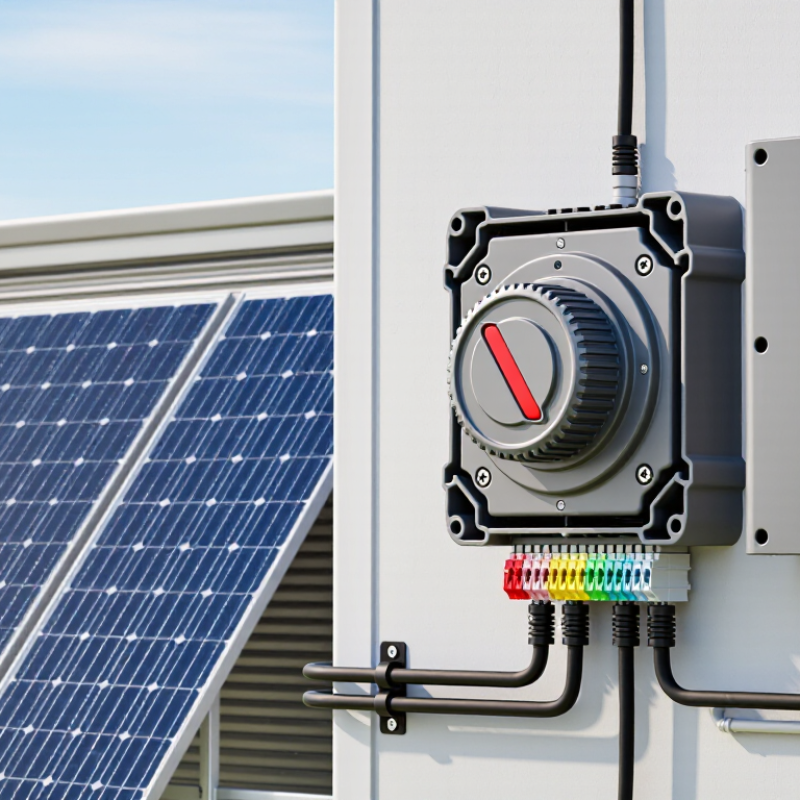
Look closely at the switch’s voltage rating, current rating, number of poles, and switching category. A switch installed outdoors may face intense sunlight, dust, rain, and temperature changes. Its enclosure should match the installation environment, such as a weather-resistant IP rating where required. Clear labeling also matters. In a real installation, a readable “PV Disconnect” label can save valuable time when visibility is poor or several circuits share one wall.

Small details matter.

The disconnect must be compatible with the inverter, wiring method, and system layout. It should interrupt the correct conductors and remain accessible to authorized personnel. Local electrical requirements and the equipment manual should guide the final decision, because ratings and placement rules can vary by region. A qualified solar electrician can verify these details before installation. No checklist is perfect. A switch may meet its basic rating yet still be unsuitable for heat, moisture, or repeated operation. This guide explains how to compare specifications, recognize common selection mistakes, and choose a Solar Disconnect Switch that supports dependable maintenance and safer photovoltaic operation.
How to Choose the Right Solar Disconnect Switch?

Define the Disconnect’s Role Under NEC 690.12 and PV Safety Requirements

How to Choose the Right Solar Disconnect Switch?

Under NEC 690.12, a solar disconnect switch has a safety role beyond shutting off equipment. It may initiate rapid shutdown, but it does not automatically make every PV conductor safe. The complete system must reduce hazardous voltage within the required time. Requirements can differ by NEC edition, system design, and local amendments.

Choose a disconnect rated for the array’s maximum voltage, continuous current, and fault conditions. Its enclosure should match the installation environment, especially outdoors, where sunlight, rain, and dust can weaken poor equipment. The switch should remain accessible, clearly labeled, and suitable for locking during maintenance. Installers must also confirm whether the disconnect is required at the inverter, service equipment, or another designated location.

Field inspections often uncover confusing labels or switches placed behind locked gates. That delay matters during an emergency. The disconnect should be easy to identify without approaching energized conductors unnecessarily. It must coordinate with rapid shutdown equipment, inverter controls, and grounding methods. Do not assume a larger switch is safer. An incorrect DC rating can create severe arcing.

A careful design review compares the one-line diagram with the actual rooftop layout. That step is sometimes skipped. It should not be. Have a qualified electrical professional verify NEC 690.12 compliance, equipment listings, conductor boundaries, and local authority requirements before installation.

Calculate Voltage and Current Ratings Using the 156% NEC Design Rule

Choosing a solar disconnect switch starts with two ratings: voltage and current. The 156% NEC design rule mainly sizes current. It combines 125% for continuous operation with 125% for photovoltaic source-circuit current. The calculation is Isc × 1.25 × 1.25. For a module with a 13.8-ampere short-circuit current, the minimum rating becomes 21.6 amperes. A 25-ampere disconnect is the practical choice, provided its voltage and interrupting ratings also fit the system.

Voltage needs a separate check. Multiply the highest open-circuit voltage by the number of series-connected modules, then apply the manufacturer’s cold-temperature correction. For example, twelve modules at 49.5 volts produce 594 volts before temperature adjustment. With a 15% cold correction, the design voltage reaches 683 volts. The disconnect should therefore carry a DC rating above this value, such as 1,000 volts, where permitted by the equipment design. NREL’s U.S. Solar Photovoltaic System and Energy Storage Cost Benchmarks reports that 1,500-volt architecture is widely used in utility-scale systems, making DC voltage verification increasingly important. The IEA’s Renewables 2024 report recorded nearly 420 gigawatts of solar additions in 2023, showing how quickly these calculations affect real installations. Field conditions can differ. I would recheck irradiance, conductor grouping, and cold-weather data before ordering. Small assumptions can become expensive failures.

How to Choose the Right Solar Disconnect Switch?

This example uses a 10-module PV string with representative unbranded nameplate values: 49.5 V open-circuit voltage, 13.7 A short-circuit current, and a voltage temperature coefficient of −0.29%/°C. At a −10°C minimum design temperature, the corrected string voltage is approximately 545 V.

The 156% current design value is calculated as short-circuit current × 1.25 × 1.25: 13.7 A × 1.56 = 21.4 A. Therefore, the disconnect should have a continuous current rating of at least 21.4 A and a voltage rating above the cold-corrected 545 V string voltage. A 600 V, 30 A disconnect exceeds both calculated minimums. Always verify the final selection against the applicable NEC edition, local requirements, equipment listing, and the complete PV system design.

Select Pole Configuration and DC Load-Break Capability for the Array

How to Choose the Right Solar Disconnect Switch?

As solar arrays grow, correct DC isolation becomes more important. IEA PVPS Trends 2024 reported about 407 GW of new photovoltaic capacity in 2023. IRENA recorded approximately 1,419 GW of global solar capacity by year-end. More installed capacity means more current paths to isolate safely.

Choose the pole configuration from the circuit design, not the panel count. A two-pole switch commonly isolates both positive and negative conductors in a floating DC circuit. A four-pole model may suit systems requiring separate isolation of multiple circuits. However, grounded systems can require a different arrangement. Follow the system diagram and local electrical rules. Do not guess.

The switch must carry the array’s maximum voltage and current under expected conditions. Its DC load-break rating matters more than a basic isolation rating. Look for certification aligned with IEC 60947-3 and the correct photovoltaic utilization category, such as DC-PV2 where applicable. Check open-circuit voltage during the lowest temperature. Check current at the highest irradiance. Add temperature derating, enclosure limits, and parallel-string current. Details matter.

A field inspection often reveals one weak point: a switch rated for voltage, but not for breaking loaded DC current. That shortcut can create severe arcing. I would also question oversized pole counts. Extra poles do not automatically improve safety. They may complicate wiring and maintenance. Select only the conductors that must be interrupted, then verify the rating with the installer’s calculations.

Match NEMA or IP Enclosure Ratings to Outdoor Solar Conditions

How to Choose the Right Solar Disconnect Switch?

Outdoor solar disconnect switches face rain, dust, salt, heat, and sudden temperature changes. The enclosure rating must match the installation, not just the switch voltage.

NEMA ratings describe construction and environmental protection. NEMA 3R suits outdoor rain exposure, but it may not protect against dust or corrosion. NEMA 4 adds protection against windblown dust and water jets. NEMA 4X adds corrosion resistance, which matters near coastlines or fertilizer storage areas. IP ratings use a different system. IP65 protects against dust and low-pressure water jets, while IP66 withstands stronger water jets. They are not exact equivalents.

Climate data makes the choice more practical. NOAA’s 1991–2020 Climate Normals record about 67 inches of annual precipitation in Miami, compared with roughly 8 inches in Phoenix. A coastal site also faces salt spray, even when rainfall is moderate. The National Renewable Energy Laboratory reports typical photovoltaic degradation near 0.5% per year, often linked to outdoor stressors such as moisture, heat, and ultraviolet exposure. A poorly sealed disconnect can accelerate maintenance problems.

Inspect the mounting surface, cable entries, drainage, and gasket condition. Select a NEMA 4X enclosure for humid, salty, or chemically aggressive locations. IP66 may be suitable where dust and heavy spray dominate. I would not assume a higher number always means better protection. Compatibility, certification, and correct installation still decide performance. One missed cable gland can undermine the entire rating.

How to Choose the Right Solar Disconnect Switch? - Match NEMA or IP Enclosure Ratings to Outdoor Solar Conditions

Outdoor Solar Condition Typical Exposure Recommended Minimum NEMA Enclosure Comparable IP Protection Level* Important Selection Features Suitability for Solar Disconnects
Covered outdoor location Limited rain or snow exposure, such as beneath a suitable canopy; no hose-down cleaning. NEMA 3R Often associated with IP24 or higher, but not an exact equivalent. Rain protection, drain provisions, outdoor-rated materials, and a temperature rating appropriate for the installation. Acceptable only where the disconnect is protected from direct water spray and severe weather.
Fully exposed rooftop or ground-mounted array Direct rain, wind-driven rain, snow, sleet, dust, and sunlight. NEMA 3R; use a higher rating if dust, corrosion, or washdown is expected. IP54 to IP65, depending on dust and water exposure. UV-resistant enclosure, corrosion-resistant hardware, gasketed door, secure cover, drainage strategy, and outdoor temperature capability. Common baseline for outdoor photovoltaic disconnect applications when installed according to the enclosure instructions.
Dusty, sandy, or agricultural environment Windblown dust, pollen, soil, grain dust, or airborne particles near fields and unpaved areas. NEMA 4 or NEMA 4X IP65 or higher for dust-tight protection. Dust-tight gasket, sealed cable entries, reliable door compression, and maintenance access that does not compromise the seal. Preferred where dust accumulation could affect terminals, switching components, or insulation clearances.
Coastal or salt-air installation Salt spray, humid air, condensation, and accelerated corrosion near the sea. NEMA 4X IP66 is commonly selected for strong water and dust protection, but it does not by itself define corrosion resistance. Corrosion-resistant enclosure and fasteners, compatible cable glands, sealed seams, and materials suitable for salt exposure. Strong choice for coastal PV systems; verify the enclosure’s material and corrosion test information.
Frequent cleaning or washdown Low-pressure or high-pressure water spray used for equipment cleaning or dust removal. NEMA 4 or NEMA 4X IP65 for water jets; IP66 for more powerful water jets. Gasketed cover, sealed operating mechanism, correctly rated cable entries, and installation that prevents spray from entering through the bottom. Suitable when the selected switch is specifically rated for the expected spray intensity and cleaning method.
Temporary flooding or splash-prone low point Short-term immersion risk caused by stormwater, drainage failure, or snowmelt. NEMA 6P IP67 or IP68, subject to the manufacturer’s specified immersion depth and duration. Immersion-rated enclosure, sealed shaft and cable entries, elevated mounting where possible, and confirmation of the allowable immersion conditions. Use only when temporary or prolonged immersion is a credible site risk and the complete assembly is rated accordingly.
Chemical, fertilizer, or industrial atmosphere Corrosive vapors, fertilizer residue, cleaning chemicals, or industrial pollutants. NEMA 4X, subject to material compatibility IP65 or higher may be appropriate, but IP does not specify chemical resistance. Verify enclosure, gasket, window, handle, terminal, and cable-gland materials against the chemicals present at the site. Appropriate only after confirming chemical compatibility; a high IP rating alone is not sufficient.

Selection Notes

  • NEMA and IP ratings use different test systems and should not be treated as exact one-to-one equivalents.
  • The IP first digit describes protection against solid particles, while the second digit describes protection against water.
  • NEMA 4X adds corrosion resistance to the environmental protection associated with NEMA 4; the exact materials and corrosion performance still need to be verified.
  • Choose the disconnect’s voltage, current, pole configuration, DC switching capability, and short-circuit rating separately from the enclosure rating.
  • Follow the applicable electrical code, local inspection requirements, and the disconnect manufacturer’s installation instructions.

*IP references are practical guidance only. NEMA and IP classifications are based on different standards, so the enclosure documentation should be checked for the exact tested protection level and installation conditions.

Verify UL 98B, UL 1741, IEC 60947-3 Certification and System Compatibility

Choosing a solar disconnect switch starts with certification, not appearance or price. UL 98B confirms suitability for photovoltaic disconnect applications. UL 1741 addresses power conversion equipment and related system safety. IEC 60947-3 covers low-voltage switchgear, including disconnectors and switch-disconnectors.

These standards are not interchangeable. Check the certification mark, product file details, voltage, current, and intended use. A switch may carry one standard but still fail your installation requirements. That detail is often missed.

System compatibility matters just as much. Confirm the maximum DC voltage, continuous current, short-circuit rating, and number of poles. Review whether the switch is rated for load breaking under photovoltaic conditions. The enclosure must also match the environment. Outdoor arrays may face rain, dust, salt air, and severe temperature changes.

Inspect terminal sizes and conductor materials before ordering. Loose connections create heat, even when the switch is correctly certified. Verify compatibility with the inverter, combiner box, cable size, and grounding method. Local electrical rules may require additional markings or spacing. Never assume an IEC-rated device satisfies every regional requirement.

A field checklist helps. Photograph the nameplate, compare ratings with the design documents, and confirm the installation manual. This takes minutes. It can prevent an expensive replacement. Certification reduces risk, but it does not replace careful system review.