Menü öffnen Menü schließen

7 Tips for Choosing an Alloy Wheel Curing Oven

Choosing an Alloy Wheel Curing Oven is a production decision, not just a matter of buying a heated cabinet. The right system must deliver even temperatures across rims, support a steady line pace, and fit the coating process you actually use. Small details matter. A crowded rack, uneven airflow, or a slow recovery after the door opens can leave finish quality inconsistent and disrupt a shift.

As [verified alloy-wheel curing specialist’s name] puts it, “A reliable cure starts with consistent heat where the wheel sits—not just the temperature shown on the control panel.” That is a useful test when comparing ovens. Ask how temperature uniformity is measured, where sensors are placed, and whether the supplier can share data from a loaded oven. Then look closely at usable chamber dimensions, airflow design, controls, energy use, maintenance access, and after-sales support.

The seven tips in this guide turn those questions into a practical selection process. They help you compare equipment against real workshop conditions: wheel sizes, rack layouts, daily output, and available floor space. Not every specification tells the whole story. A brochure may promise precision, while your own trial reveals cold spots near a loaded rack. Check the evidence. Keep room for doubt, too; a technically capable oven may still be the wrong fit if it slows your line or complicates routine maintenance.
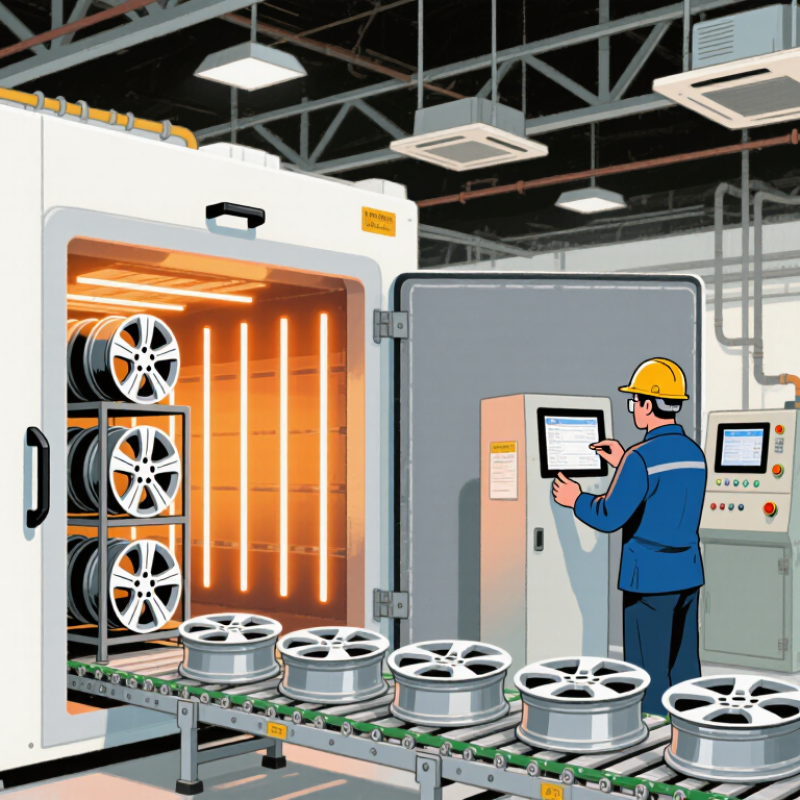
7 Tips for Choosing an Alloy Wheel Curing Oven

Understand the Alloy Wheel Curing Process and Its Requirements

Alloy wheel curing begins with the coating’s chemistry, not a generic oven setting. Powder and liquid coatings can require different time-temperature schedules, so follow the coating supplier’s technical data sheet. The critical measure is usually the wheel’s metal temperature, not the oven’s displayed air temperature. Not just oven air. Thick hubs and spoke junctions heat differently from thin rim sections. A contact thermocouple on a representative wheel helps verify when the required metal temperature is reached and held.

The U.S. Department of Energy’s 2016 Improving Process Heating System Performance: A Sourcebook for Industry estimates that process heating accounts for about 36% of U.S. manufacturing energy use. That makes insulation, airflow, and sensible loading worth checking—not just maximum temperature. Leave space between wheels so heated air can circulate around the spokes and inner barrel. Record actual temperature curves across test cycles; an oven display alone cannot confirm a uniform cure. A minor weakness in many setup plans is testing only one wheel geometry. Different designs may heat unevenly, so validate the schedule with representative wheels before relying on it for routine production.

Match Oven Capacity and Configuration to Your Production Needs

Match the oven to the wheels moving through it, not just the largest wheel in your catalog. Record wheel diameter, width, weight, and hourly output, then calculate how many wheels must be inside during the full cure cycle. For batch ovens, check usable rack area and loading clearance; for conveyor systems, set belt speed and spacing around the required dwell time. Leave room for uneven demand and future models. Small details matter.

The U.S. Energy Information Administration’s 2018 Manufacturing Energy Consumption Survey recorded 22.1 quadrillion Btu of energy use across U.S. manufacturing. That figure is not specific to wheel ovens, but it highlights why avoidable empty heating capacity deserves attention. Compare expected loads, warm-up time, door openings, and shift patterns before choosing a chamber. A tidy spreadsheet can still be wrong if it assumes every shift runs at full rate. Confirm the cure schedule against the coating supplier’s specifications, then use thermocouples on representative wheels to check actual metal temperature. A larger oven may ease loading, but it can also heat unused space; a smaller one may create queues. The right configuration depends on measured flow, not guesswork.

Evaluate Temperature Uniformity and Control Accuracy

When comparing alloy wheel curing ovens, separate temperature uniformity from control accuracy. Uniformity describes temperature differences across the working space; control accuracy describes how closely the displayed value matches the actual temperature. An oven may hold its sensor reading steadily while a wheel near the door runs cooler. That matters.

Check temperature performance with a loaded oven, not just an empty chamber. Place calibrated probes near the upper and lower racks, at the center, and close to the door. Record readings during heat-up, the full cure period, and cooling. A smooth control-panel display is not enough. Look for repeatable results across several cycles, and compare them with the coating supplier’s specified cure window. The required tolerance depends on the coating and process, so avoid choosing a number by guesswork.

Ask how often sensors are calibrated and how the controller responds when readings drift. Review the actual temperature map, including the time needed to recover after loading. Small detail. A brief door opening can change conditions near the entrance, even when the central probe barely moves. Keep in mind that a single test can miss uneven loading or probe placement errors. It is worth questioning a perfect-looking chart; real production rarely behaves so neatly.

Compare Energy Efficiency, Safety Features, and Build Quality

An alloy-wheel curing oven should be judged by energy used per loaded batch, not its empty-chamber rating. The U.S. Department of Energy’s Improving Process Heating System Performance sourcebook estimates that process heating consumes about two-thirds of manufacturing energy. Ask suppliers for measured consumption, warm-up time, and temperature uniformity under a realistic wheel load. Compare like with like. A low quoted cycle time means little if the oven needs long recovery periods between batches.

Safety details matter on the shop floor. Look for independent over-temperature protection, door interlocks, reliable airflow monitoring, and clear alarms. Verify that controls prevent heating when circulation fails, and check how operators can safely unload hot wheels. Small details count. A handle that stays cool is not a substitute for a documented safety procedure.

Build quality shows in insulation joints, door seals, welded seams, and fan access for maintenance. Inspect these areas, not just the exterior panels. I would not assume thicker sheet metal guarantees better performance; poor sealing can waste heat, and a strong specification can still be poorly assembled. Request temperature-mapping results and service records, then compare them with your wheel sizes and daily batch pattern. Real operating data beats a polished brochure.

7 Tips for Choosing an Alloy Wheel Curing Oven — Compare Energy Efficiency, Safety Features, and Build Quality

Tip What to Compare Evidence or Specification to Request Why It Matters Practical Buyer Check
1. Match the oven to the coating process Usable chamber dimensions, wheel capacity, loading method, and operating temperature range. Internal dimensions, maximum load, temperature range, and the coating supplier’s required part-metal temperature and cure time. Powder-coating cure schedules vary by coating formulation and are generally specified for the part itself, not just the oven-air temperature. Confirm that the largest planned load fits with adequate space for airflow. Check the coating technical data sheet before selecting a temperature range.
2. Compare energy use under the same conditions Energy consumed per production cycle, heat-up time, insulation, and heat loss during operation. Measured energy use for a defined cycle, including the load, starting temperature, setpoint, and hold time. Request insulation details and door-seal specifications. Rated heater power alone does not show how much energy an oven uses to process a batch; cycle conditions and heat retention also affect consumption. Compare kWh per cycle using equivalent loads and temperature schedules. Ask whether the quoted figure is measured or estimated.
3. Check temperature uniformity with a loaded chamber Temperature distribution throughout the chamber and repeatability between cycles. A temperature-uniformity test report, including sensor locations, test conditions, and results with a representative load where available. Even heating helps each wheel receive the intended cure. An accurate controller reading at one point does not, by itself, demonstrate uniform chamber temperature. Ask how the oven is tested and where its control and monitoring sensors are placed. Verify the result against the coating process requirements.
4. Review independent safety protections Over-temperature protection, alarms, emergency stop, door or airflow interlocks where applicable, and safe shutdown behavior. Electrical and control-system documentation, safety device list, operating instructions, and details of applicable local codes or standards. Independent protective devices and clear operating procedures help reduce risks from overheating, equipment faults, and incorrect operation. Confirm which protections are standard, how faults are indicated, and whether the equipment is designed for the installation jurisdiction and intended process.
5. Assess ventilation and process separation Air circulation, exhaust or ventilation requirements, and separation from powder application activities. Airflow design information, installation clearances, ventilation requirements, and written guidance on permitted oven use. A curing oven must be installed and operated for its intended purpose. Powder application and curing should follow suitable separation and process-safety controls. Do not assume an oven is suitable for spraying or powder application. Have the proposed layout and ventilation reviewed for local requirements.
6. Inspect construction and serviceability Chamber materials, insulation installation, door construction, seals, structural frame, and access to service components. Construction drawings or material specifications, maintenance schedule, replaceable-part list, and warranty terms. Well-documented construction and accessible components can support reliable operation and make inspection and maintenance easier. Inspect door alignment and seals, ask how heating elements and controls are serviced, and confirm the availability of replacement parts.
7. Compare controls, records, and support Programmable temperature settings, cycle monitoring, data logging, operator usability, and technical support. Control-system functions, sample cycle records, training materials, commissioning scope, and response arrangements for service support. Consistent settings and usable records help operators repeat approved cycles and investigate process deviations. Ask for a demonstration using a representative cycle. Check whether operators can review setpoint, measured temperature, alarms, and cycle history.

Note: Confirm curing schedules with the coating manufacturer and verify equipment, installation, ventilation, and safety requirements against applicable local regulations. Energy figures should be compared using equivalent cycle conditions and loads.

Review Installation, Maintenance, and Supplier Support

Before choosing an alloy wheel curing oven, check the installation conditions at your actual workshop. Measure doorways, ceiling height, and floor space, including room to load a wheeled rack safely. Confirm electrical capacity, ventilation needs, and the floor’s rated load with qualified site personnel. A layout drawing can catch problems early. It is easy to underestimate clearance.

Ask the supplier what installation includes: delivery, positioning, commissioning, and operator training. During handover, staff should learn how to set a cure schedule, verify temperature readings, and respond to an alarm. Request maintenance intervals and a list of wear parts, such as door seals, filters, and temperature sensors. Keep a simple log of inspections and temperature checks; small changes can reveal trouble before production is affected. Still, logs do not replace proper calibration.

Supplier support matters after commissioning. Ask how quickly technical staff respond, whether replacement parts are stocked, and what information they need to diagnose faults remotely. Get support terms in writing, including coverage hours and service costs. If possible, speak with a workshop using a similar oven and ask about downtime, not just performance. Some details may remain unclear until the oven is running in your space. That deserves attention.

7 Tips for Choosing an Alloy Wheel Curing Oven

Compare key buying considerations, including installation, maintenance, and supplier support.

Example planning scores on a 1–5 scale, where 5 indicates a higher priority. These are illustrative buyer-assessment scores, not survey results; adjust them to your production needs. Confirm oven capacity, temperature performance, site requirements, maintenance access, and service coverage with suppliers.