

Menü öffnen Menü schließen

7 Cable Protection Sleeve Buying Tips for Global Buyers

Global cable assemblies face vibration, abrasion, moisture, heat, and frequent movement. A suitable Cable Protection Sleeve can reduce these risks, but product selection is rarely simple. Buyers must examine sleeve material, temperature range, flexibility, expansion ratio, flame behavior, and installation conditions. A sleeve that performs well inside a clean control cabinet may fail beside a hot engine or exposed conveyor.

Cable-management engineer Dr. Laura Bennett explains, “Protection begins with understanding the cable’s real working environment, not merely choosing the thickest sleeve.” This practical view matters for international purchasing teams. A heavy sleeve may increase weight, restrict bending, or complicate maintenance. A low-cost option may also create hidden replacement expenses. Small details matter, such as a 6-millimeter cable bundle entering a tight 90-degree bend, or a sleeve exposed to oil every afternoon.

This guide presents seven Cable Protection Sleeve buying tips for global buyers. It considers product performance, supplier communication, documentation, packaging, and long-term value. Buyers should request samples and test them under realistic conditions. That step is often skipped.

The market is not perfectly standardized. Product names, test methods, and supplier claims can differ between regions. Careful comparison remains essential. Sometimes, the first specification is wrong. Rechecking it is good purchasing practice. By combining field experience with measurable requirements, buyers can reduce installation problems and select protection that remains dependable across demanding applications.
7 Cable Protection Sleeve Buying Tips for Global Buyers

Define Sleeve Types: PET, Nylon, Fiberglass, and Spiral Wrap by Use Case

PET, Nylon, Fiberglass, or Spiral Wrap? The right cable sleeve depends on the working environment, not appearance. A 2024 Grand View Research analysis estimates the global cable management market will grow strongly through 2030, driven by data centers, vehicles, and industrial equipment. That growth makes material selection more important for global buyers.

PET braided sleeving suits cable bundles needing abrasion resistance, airflow, and easy expansion. It works well behind control panels and inside equipment frames. Nylon offers tighter protection and better resistance to rubbing, oils, and repeated movement. Use it near moving assemblies, but verify its temperature rating. PET is not automatically the cheaper answer.

Fiberglass sleeving handles higher temperatures, especially with a silicone coating. It fits near motors, heaters, and engine compartments. Check continuous temperature data, not only short-term peak ratings. Spiral wrap is different. It supports quick routing, branch exits, and field repairs, but leaves gaps between turns. It is flexible, not sealed protection.

A 2023 MarketsandMarkets report identifies industrial automation and transportation as major cable management growth areas. Those environments often combine heat, vibration, chemicals, and tight bends. One sleeve may not solve every risk. I have seen neat installations fail because the sleeve compressed against a sharp edge. Recheck bend radius, flame behavior, cleaning chemicals, and installation tools before approving a purchase. Supplier test reports should support every claimed rating.

Check Fit: Match Cable OD, 2:1 Expansion, and Bend Radius

Check Fit Before You Buy

Global electricity demand is forecast to grow by about 3.4% annually from 2024 to 2026, according to the IEA Electricity 2024 report. More equipment means denser cable routes and less installation space. Sleeve selection must start with measurement, not appearance.

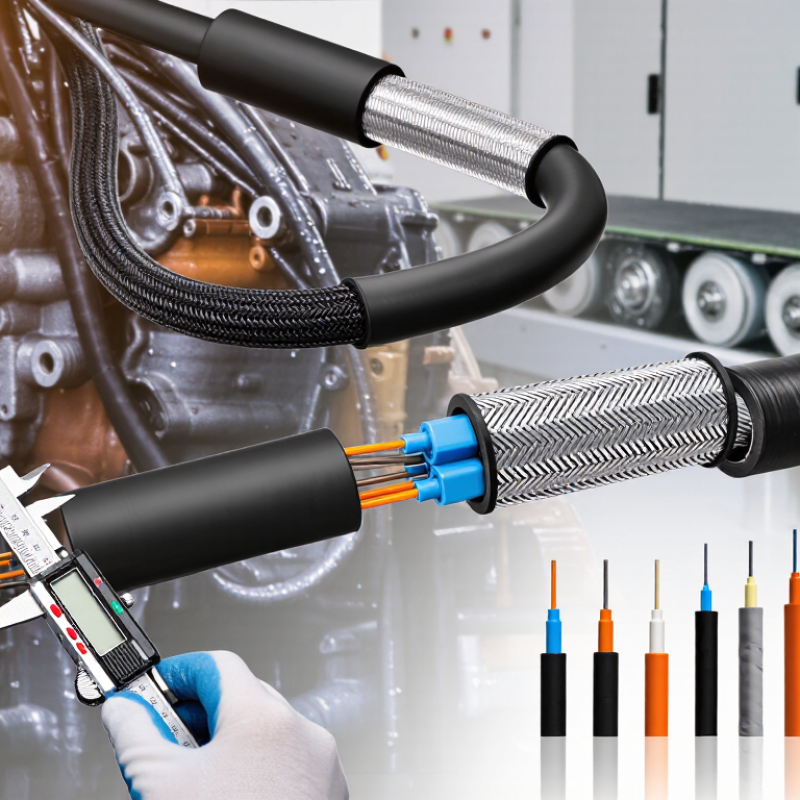
Measure the cable’s outside diameter with a caliper, including insulation irregularities. A 2:1 sleeve can expand to twice its recovered diameter, but that is a limit, not a target. For a 10 mm cable, a sleeve expanding to 10 mm may fit tightly. A modest allowance usually makes installation safer. Check the largest connector first. I once treated the cable diameter as the only dimension, and the termination ruined an otherwise correct selection.

Bend radius deserves equal attention. IEC 62444 provides cable-gland installation guidance, while the cable manufacturer’s minimum bend radius remains the controlling value. A sleeve may protect abrasion points, but it cannot cancel a cable’s mechanical limit. Measure the bend at the tightest turn, then add enough sleeve length to prevent edge lifting. Industry cable-management reports published in 2024 continue to identify installation reliability as a major purchasing concern. That sounds obvious, yet field failures often begin with rushed measurements. A simple trial fit can expose this mistake.

Verify Protection: IEC 60529 IP54–IP68 and Abrasion-Test Evidence

7 Cable Protection Sleeve Buying Tips for Global Buyers

Verify Protection: IEC 60529 IP54–IP68 and Abrasion-Test Evidence

Protection claims need technical evidence, not attractive labels. IEC 60529 defines IP54 as dust-protected with resistance to water splashes. IP65 adds dust-tight construction and water-jet protection. IP66 covers powerful water jets. IP67 requires temporary immersion up to one metre for 30 minutes. IP68 depends on agreed immersion conditions, so request the actual depth and duration.

IP ratings do not measure abrasion. That distinction matters. A sleeve may pass an IP test, yet wear through against a sharp tray edge. Ask for abrasion reports showing the test method, load, stroke count, surface material, and failure limit. ISO 12947 can support textile abrasion comparisons, but its results may not represent cable-tray movement. The report should identify sleeve construction and sample conditioning.

Check the details closely. Was the sample tested with connectors installed? Were seams, closures, and cut edges included? A report covering only flat fabric is incomplete. I once treated a high IP rating as full protection. That was too optimistic. A strong purchasing file should connect IEC 60529 results with application-specific abrasion evidence, temperature data, and installation photos. Independent laboratory records are more credible than a supplier’s single-page declaration.

Screen Safety: UL 94 V-0, RoHS, REACH, and −40°C to +150°C Ratings

7 Cable Protection Sleeve Buying Tips for Global Buyers

When buying cable protection sleeves, check the actual safety documents, not only the product label. UL 94 V-0 means the tested material can stop burning within defined limits. It does not make the sleeve fireproof. Ask for the test report, material grade, thickness, and flame direction used during testing. A thin sleeve may pass one test but perform differently after bending, abrasion, or installation.

RoHS compliance helps control restricted substances in electrical products. REACH documentation addresses chemical substances and reporting duties. These are not interchangeable certificates. Request a current declaration, test date, material composition, and traceability details. Keep the records with your purchasing file. It saves time during audits. Sometimes, buyers accept a generic statement too quickly. I have learned that this shortcut creates uncertainty later.

The temperature range of −40°C to +150°C must match the complete application. Check continuous exposure, short-term peaks, oil contact, sunlight, vibration, and nearby heat sources. A sleeve rated to +150°C may lose flexibility before reaching that limit. Measure the cable bundle after connectors are fitted. Leave enough room for movement, but avoid excessive looseness. Sample testing is essential. Test cold flexibility, heat aging, flame behavior, and installation damage. One detail is easy to miss: cutting the sleeve can expose weak edges. Review that cut condition before approving a global shipment.

7 Cable Protection Sleeve Buying Tips for Global Buyers - Screen Safety: UL 94 V-0, RoHS, REACH, and −40°C to +150°C Ratings

No. Buying Tip Key Specification Recommended Buyer Requirement Why It Matters Verification Evidence
1 Define the operating temperature range Continuous service temperature: −40°C to +150°C Specify both continuous and short-term temperature limits. Require the sleeve to remain flexible and mechanically stable throughout the stated range. Temperature exposure can cause shrinkage, embrittlement, softening, or loss of abrasion protection. Technical data sheet, material specification, and temperature-cycle test report covering the intended range.
2 Confirm flame-retardant performance UL 94 V-0 material classification Require a valid UL 94 V-0 rating for the exact polymer, coating, or construction used in the sleeve—not only for a similar material family. V-0 indicates rapid self-extinguishing behavior under the UL 94 vertical burning test and limits flaming drips that can ignite cotton. Recognized laboratory report or certification documentation identifying the tested material thickness and construction.
3 Check RoHS substance limits RoHS restricted substances by homogeneous material Require a current RoHS declaration covering the sleeve, pigments, coatings, lubricants, labels, and any attached components. The EU RoHS framework restricts specified substances in electrical and electronic equipment, including lead, mercury, cadmium, hexavalent chromium, PBB, PBDE, and four phthalates. Supplier declaration supported, where required, by analytical screening such as XRF and laboratory chemical testing.
4 Review REACH obligations SVHC communication threshold: above 0.1% by weight in an article Request a REACH Article 33 declaration and the latest SVHC screening date. Confirm whether any candidate-list substance exceeds 0.1% w/w. REACH communication duties may apply to finished sleeves, additives, coatings, and packaging components supplied into the European market. Signed REACH declaration, material disclosure, and test results for higher-risk additives or recycled content.
5 Match sleeve size to cable bundles Nominal diameter, expansion range, and installation method Measure the bundle outside diameter, connector size, bend path, and end-access requirements. Select a sleeve whose stated expansion range covers the complete bundle. An undersized sleeve may damage connectors during installation; an oversized sleeve can move, bunch, or reduce abrasion protection. Dimensional drawing, expansion data, sample-fit inspection, and installation trial using the largest connector in the assembly.
6 Evaluate mechanical protection Abrasion, cut, tensile, and flexibility performance Set project-specific minimum values and test methods. For moving cables, also require repeated-bend or flex-cycle validation under the intended bend radius. A sleeve suitable for stationary wiring may fail in robotics, vehicle harnesses, or equipment with frequent vibration and movement. Mechanical test report, application samples, bend-cycle results, and visual inspection for fraying, cracking, or flattening.
7 Control traceability and global documentation Batch consistency, labeling, packaging, and change control Require lot or batch identification, certificate of conformity, country-of-origin details, packaging specifications, and notification before material or process changes. Traceability simplifies customs clearance, incoming inspection, field investigations, and repeat purchasing across regions. Pre-shipment inspection record, retained sample, batch certificate, packing list, and controlled revision history.
Important: UL 94 V-0 is a flammability classification for a specified material and thickness. It does not by itself certify the complete cable assembly, electrical insulation system, or installation. Temperature, RoHS, REACH, and mechanical claims should be verified for the exact finished sleeve construction.

Audit Global Supply: MOQ, IEC Test Reports, Lead Time, and Landed Cost

When sourcing cable protection sleeves globally, treat MOQ as a production risk, not a discount. Ask whether the MOQ applies per color, diameter, or shipment. Request the supplier’s monthly capacity and rejection rate. UNCTAD’s Review of Maritime Transport 2023 states that over 80% of global merchandise trade moves by sea. Port disruption can therefore affect even a small sleeve order.

Get it in writing. IEC 60684-3 requirements should match the sleeve’s material, wall thickness, shrink ratio, temperature range, and flame performance. Check whether the test report identifies the exact product code and production lot. An ISO/IEC 17025-accredited laboratory adds credibility, but a report still needs traceability. Do not guess. In practical audits, expired reports and incomplete test conditions appear more often than buyers expect. The World Bank’s 2023 Logistics Performance Index compared 139 economies and highlighted major differences in customs, infrastructure, tracking, and timeliness. Build that variation into the lead-time plan.

Calculate landed cost, not only the factory price. Include tooling, packaging, ocean or air freight, insurance, duties, broker fees, testing, and local delivery. Confirm the Incoterm and currency before comparing quotations. A supplier offering a 12-day lead time may exclude testing or consolidation time. Add a written buffer for approval, inspection, and port handling. A simple spreadsheet helps, although it can hide weak assumptions. Recheck it against one real shipment. That hurts. But it exposes the cheapest-looking mistake.